
Objectives
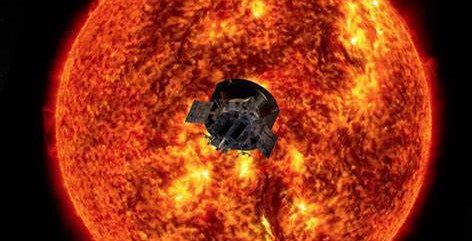
Your challenge is to develop a creative way to tell young audiences the story of how Parker Solar Probe became the first human-made object to enter the Sun’s atmosphere—including all the dangers Parker Solar Probe encountered and overcame on its way to the Sun and what lessons we could learn from Parker’s journey.
You may use any medium you would like to tell the story including original poetry or spoken word, song lyrics, a short story, a comic strip, a board or video game, interpretive monologue, etc.
MUST BE INCLUDED
- A clear plot (beginning, middle, and end)
- Character conflict (How does the character struggle with something? For example, the struggle can be with itself, another being, nature or natural forces, technology, etc.)
- Simple explanations of space weather phenomena that Parker encounters on its journey—including extreme temperatures, dust, the solar wind, and solar storms—and how these phenomena can impact life on Earth.
- Parker Solar Probe’s interactions with Venus (gravity assists).
How can you educate and excite young audiences about this remarkable record-setting mission?
Potential considerations
- Other phenomena created by the Sun, such as eclipses and aurora.
- The design of Parker Solar Probe’s heat shield.
- Parker Solar Probe’s records – fastest human-made object and first human-made object to touch the Sun.
- What we’ve learned about Venus from Parker Solar Probe.
- Earth’s upper atmosphere (ionosphere) – where the International Space Station orbits.
- Earth’s magnetosphere – created by the Earth’s core and protects us from the Sun.
- Lagrange Point 1 (L1) – the place between Earth and the Sun where the gravitational pull of the two large objects precisely equals the centripetal force required for a small object to move with them.
Resources
 Harshil Sajan