Awards & Nominations
Team Aphrodite has received the following awards and nominations. Way to go!
Global Nominee

Team Aphrodite has received the following awards and nominations. Way to go!
To attract attention of young people we decided to make our story based on a comic book. We wanted them to learn Parker Solar Probe's journey while having fun because nearly every young people prefers to read comic books to reading articles. So we turned Parker Solar Probe into a character to make our storyline much more fun. Down below there’s a demo part that you can reach the slides that will inform you about our project. And just a little down below that there is a final project part that you can see our animated and non animated comic book pages and nearly everything we did for our project last week.
In our project, we turned the story of Parker Solar Probe into a comic book that young people can enjoy reading. We have simplified the process from the moment that the Parker Solar Probe takes off to the moment that parker solar probe enters the corona layer.
Our team included 1 artist, 1 editor, 2 researchers , and in the On The Way To The Sun challenge we were asked to tell the story of the parker solar probe using art in a creative way. Therefore, we saw that this project was very suitable for our team and we decided to choose this challenge.
In this challenge, we decided to make a comic book because we were asked to tell the story of Parker towards the sun in a fun way to a young audience. In this comic, we turned the parker solar probe into a character we designed.
We wanted our name to be related to our topic. Our team is named after Venus (twin of earth) which is the Roman name of APHRODITE who is the the goddess of love and beauty.
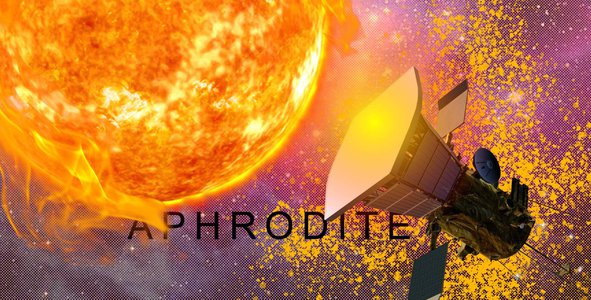
Most important things were the sun and Parker solar probe. So we asked our editor to make us a logo that would include both of them. And she came up with this one. After all of the team team members approval we decided to make it our logo.

In our team DEFNE KARACA took the role of an artist .
In the drawing process we made the pages one by one. First we decided what to do on that page, then Defne drew The patterns and the sketch. Right after that , she did base coloring, She put the shadows and draw the line art. It took about two and a half hours to draw each page. And finally we sent those pages to our editor to be edited. The drawings were drawn via procreate and the reference photos were viewed on Pinterest.

In our team DİDE YAĞMUR DELİMEHMET took the role of the editor.
In the editing process first we choose the music for our animated short video of our comic book. While doing that we paid attention to choose a music that fits our team. Dide put the dialogues and other information that researchers wrote in the comic book pages. Right after that Dide animated the comic book pages. Finally we showed our project to multiple mentors and reorganized some of the parts that the mentors told us to change. And just like that we came up with the final result of our project.We mostly used after effects for editing in our project. We used Youtube for some video and music, and a Capcut PC to combine the videos we made separately.

In our team DİLA NAZ YİĞİT and DİLA DURU GÜNDÜZ took the role of researchers
During the research, great care was taken to ensure that the sites where information was collected are reliable. During the research process, many different articles were read, especially from NASA's own website. Parts of these articles that we found important were briefly noted and these notes were combined at the end of the research. In the slides and the information on the comic book pages, the information we obtained as a result of our research was used

In this comic, we turned Parker Solar Probe into a character to make the story flow more fun. And we tried to convey to this character most of what Parker Solar Probe really has.
1) The screen where she can see her location in space and makes it easy for her to communicate with the world (we added this device to the character view that does not exist in the real parker solar probe)
2) This sensor above its head counts the most abundant particles in the solar wind and measures properties such as speed, density and temperature to improve our understanding of the solar wind and coronal plasma.
3) The carbon plate on the head ensures that the head is constantly facing the sun and protects the body part from the harmful effects of the sun.
4) These receivers and transmitters communicate with the world.
5) We used the character's eyes as parker's camera. This camera allows taking photos of Venus and the Sun.
6) The antennas here are the antennas required to process the data correctly.
7) We placed the solar panels in Parker on our character's clothes. It provides energy to itself with these panels.
8) We reflected the rockets parker used to enter its post-launch orbit as our character's boots.

We got most of the information we used while preparing our project from official websites of NASA and TUBITAK or other reliable youtube channels. NASA's resources section contained a lot of useful information supported by images and videos, so we conducted most of our research here because it is both reliable and covers a very wide area.
We talked about the topic at school on the second day. And when we went home we decided to the topic as On the Way to the Sun. We were really excited and talked about it at every break-time.
Then here comes the weekend and the starting of the main things. Which way are we going to choose the way of telling an exciting story? We had an artist and decided to have pictures and information near them. Finally we said "Teens really love reading comics, we should make a comic book for a more exciting and interesting expression!" And for the demo part we thought making slides could be good. There is really no area of the website that we haven't looked at and we have created a base thing on our minds about our project by examining the projects of the previous winning teams.
Our artist talking about the first weekend:
"In the first weekend I drew 23 hours total. It was really tiring for me because it was my first time drawing a comic book. Also I wanted it to be detailed but our time was really limited and it was nearly impossible to do. Although I think I did my best in that kind of little time, my teammates my classmates and my family was really supportive to me so I really thought that was the reason for being able to spent time drawing nearly half of my time at the first weekend."
Our artist talking about the week ;
‘’At Monday our whole team was super tired. We worked till really late hours at the weekend and there were only seven days left for us to finish our project and that made me really nervous because I thought I wasn’t going to finish the comic book pages on time. I was going much more slower than I thought I would. Every page was taking nearly 2 ½ hours for me to finish so that made the process much more stressful for me. That’s why I decided to simplify it as much as I could. I used some pictures I drew before again and again by adding some small details or changing it a little. My friends really believed me that I was going to finish it on time which I really appreciate. After finishing every page I sent them to our team. The researchers wrote information on those pages and sent them to our editor. I gotta say we really worked hard, our researchers read nearly all of the articles that were related to our topic. Our editor spent so much time animating the pages. At the end of Thursday the drawing of all the pages were done so I slept early that night because we had an opening ceremony at Friday night. Our reel Space Apps Challenge journey was going to start the next day.’’
Our editor talking about the first weekend:
''While I was waiting for the artist to draw, I decided to make an intro. First of all, I started looking for videos that I could use for intro. Then I decided what I was going to prepare and accordingly, I chose the approprite music with my teammates and prepared the intro. A logo appeared in my mind. Uploading the sun, Parker Solar Probe and flame pngs (I had a really hard time finding what I was looking for.)
I also put a space image for the background. After giving the light effect and an effect to the background, our logo was ready (later I added the name of our group to the logo).''
Our editor talking about the week:
''Since the pictures drawn by our artist during the week started to come in slowly, I started editing. I waited for at least two pictures to be ready because I wanted the pages to be as if they were reading a comic book in the edit. When the conditions were met, I created a composition suitable for the dimensions of the two pages and combined the pages. When the researchers delivered their texts to me. I placed them in composition. Then I made page switching and other animations. This is how this process went. I added a blink and wave animation to our character on the last page. (I made improvements on it later).
Our researchers talking about the project:
''We knew from the start that it was a project that needed to be held tight. We had to have knowledge on many subjects such as what the artist would draw, what would be talked about on the subject, and what would happen on the slide. For this reason, we, the researchers, started our task
before everyone else. We have read dozens of articles from reliable sources, especially from the official website of NASA, and besides these articles, we have watched many informative videos. Like all our teammates, we had a very tiring weekend. Reading so many articles and watching videos, taking notes on important points and not falling asleep while doing them was quite tiring. As researchers, we wrote down and gathered information from both the slide and the comic.''
On friday night we all joined NASA space apps challenge discord server. We were ready for the 48-hour-hackaton. We knew that the next two days ahead of us were going to be really hard and busy. The drawing of comic book pages were done. Our editor wrote the information on the pages, and she finished half of the page editing. At the opening ceremony we took some notes which could be useful in the next two days. We finished our meeting at 10:00 pm because we were going to wake up early the next day. On saturday morning we started our meeting 8:30am. First we checked if we did something wrong and wrote a daily program for ourselves. While our editor was finishing our page animation we started writing the tags and references part. After that we started writing high level project summary. At first we were a little worried that it was going to be too short but we nearly filled the whole part that they gave us. While our artist and one of our researchers started writing detailed project description the other researcher started making the demo slide. When our page animation and be more slight was ready we spoke with a mentor. He examined our Project in details. He shared his ideas and gave us some advice about a few things. According to his advice we reorganized our demo slides and some tiny details about our comic book pages. We had a long break between 5pm and 7pm. After we get back from our long break we started writing the detailed project description part in Turkish because we thought It would be easier for us. But actually it was harder because we also had to translate it into English. At 10:30 pm we were really tired so we finished our meeting and worked personally till we slept. On Sunday morning we started our meeting at 9:00 am. First we made a daily schedule for us right after we examined our project from the top to the end. On Sunday we had to translate our detailed project description part into English and add pictures so we could express ourselves better. We had to download our animated comic book pages video on YouTube. We had to add our demo and final project part. We had to write the space agency data part. Till afternoon more than half of those were finished so we talked with few mentors and we send our project demo to juries so that we could get feedback. We did well. According to their feedback we changed some details in our project and added a tiny storyboard that includes Pew sketches and a process of making a page. At 6:00 pm our project was nearly finished. As the final step of our project we sent our project link to a few people that didn’t have any ideas about our project. And we asked them if there were any parts which couldn’t be understood and was anything unclear. So according to their feedback we added few details and send our project to them till they told us it was understandable even for someone that had no idea about the project. When all of them said it was clear we send our project into the system.
FINAL WORDS
As a team we worked really hard for this project. And we have to admit that we are proud of what we came up with. We hope all of our work will have a good result.
https://blogs.nasa.gov/parkersolarprobe/2018/08/11/the-parker-solar-probe-mission/
https://www.youtube.com/watch?v=LkaLfbuB_6E
https://www.youtube.com/watch?v=AlyuSwRSVHU
https://www.youtube.com/watch?v=GoBPeCe4C2s
https://blogs.nasa.gov/sunspot/2021/12/11/solar-tour-pit-stop-9-the-solar-wind/
https://www.nasa.gov/feature/goddard/2018/traveling-to-the-sun-why-won-t-parker-solar-probe-melt
MUSIC REFERENCES
#parkersolarprobe #sun #venus #comic #solarwind #nasaspaceappschallenge #heatshield #tedcorum #space