Awards & Nominations
256_DATANAUTS has received the following awards and nominations. Way to go!


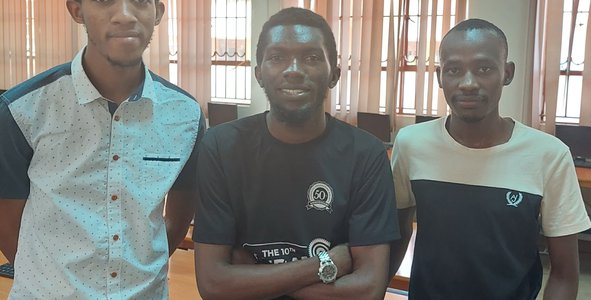
256_DATANAUTS has received the following awards and nominations. Way to go!
Over 50% of the NASA Technical Reports Server (NTRS) documents are legacy documents that were obtained by scanning and using Optical Character Recognition (OCR). These documents are difficult to access and discover in the NTRS. We have developed an AI-based web application that utilizes Natural Language Processing (NLP) to automatically read these documents, summarize them, generate text analytic data, and produce a list of topic keywords to help researchers find these documents within the NTRS. This improves the accessibility and discoverability of these documents for both scientific and historical researchers.
Corpus
Given the large number of documents in the NTRS, we use the NASA NTRS OpenAPI to automatically download legacy documents instead of manually navigating the database. This saves time and is more efficient.
We download documents belonging to 3 randomly chosen broad topics. For each broad subject category, we randomly select 2 specific subject categories. We follow the existing NASA STI Scope and Subject Category Guide when selecting these categories.
For each document in the corpus, the corresponding metadata such as document id, title, and abstract are saved in JSON files.
Assigning keywords to documents
Since each document in the NTRS has a subject category assigned to it, we obtain the corresponding keywords for that subject category. For each document in a given category, we assign the relevant keywords by finding the similarity between the document and all the keywords in that category. The keywords are then added to the corresponding JSON files.
Web application
We then developed a web-based application integrated with Natural language processing algorithms that can retrieve documents from the National Technical Report Server based on a query. The application has two features: the filter feature and the search feature.
The filter feature allows the user to filter the documents based on the subject categories. The search feature allows a user to input a query into a search bar and tap the search button to retrieve documents based on that query.
The titles, abstracts or summaries, keywords, and text analytics of the retrieved documents are then displayed on the web application interface.
Back-End
The back-end consists of three systems: the retrieval system, the text summarization system, and the text analytics system. These systems utilize natural language processing techniques to perform their respective tasks.
For the filter feature, the retrieval system returns all documents belonging to the selected subject category. For the search feature, the retrieval system compares the query with all the documents in the corpus by calculating a similarity score between the query vector and the corpus vector.
The text summarization system extracts the abstract for the returned documents. If the document does not have an abstract, the system generates an abstract for the document.
The text analytics system analyzes the contents of the whole document and retrieves relevant keywords, topics, and other related analytic information.
Front-End
The web application, with which users interface, was created using stream-lit to provide a user-friendly way of utilizing our solution. The image below shows the appearance of the interface before a query is made.
After a query is made the results are displayed on the web interface as shown in the image below.
Our solution improves the accessibility and discoverability of legacy documents by providing relevant information such as keywords, subject topics, abstracts, and summaries that guide researchers to find the desired information.
Future Work
We intend to include a feature that translates the document summaries into African languages so as to encourage more Africans into space research. We shall also extract images from these documents to generate a simple animation returned besides the abstract/summary to give researchers more insights into the documents.
GitHub repo:
The code used in this project can be found at this link:
https://github.com/PaulOkwija/NTRS-Document-Retrieval-System
This also contains a folder called "corpus" that contains documents whose names represent the document id.
We used open data from the NASA Technical Report Server legacy CDMS center (https://ntrs.nasa.gov/search?center=CDMS) which provided records to thousands of documents and reports. We used these documents to create a corpus which was used to develop the retrieval, text summarization, and analytics systems.
We also used the NASA NTRS OpenAPI to automatically download 81 documents based on the subject category.
We also used the NASA STI Scope and Subject Category Guide to generate subject categories and keywords.
Participating in this challenge was based on a strong interest and love for space. Coming to this challenge, we never expected to be working on a natural language processing task. We thought the NASA Space Apps Challenge was mainly to deal with topics about space. However, we found this natural language processing task interesting and decided to take it on. We had no prior experience with NLP save for our machine learning background mainly in computer vision.
This challenge has taught us how to structure and execute projects in the shortest time possible. We learned the power of the Kanban board for effective teamwork. We never thought we could pull this off, but through hard work and focus, we are proud of what we managed to build.
We thank the Science Technology and Innovation (STI) secretariat of Uganda and the College of Engineering Design Art and Technology at Makerere University, Kampala for their support and guidance throughout this challenge. We are forever grateful.
Last but not least, we thank NASA for organizing this challenge. It was a very inspiring challenge to learn more about space.
#Streamlit #Python programming #NLP #Gensim #Google Colab


