Awards & Nominations
Curiosity CEDHU has received the following awards and nominations. Way to go!
Global Nominee

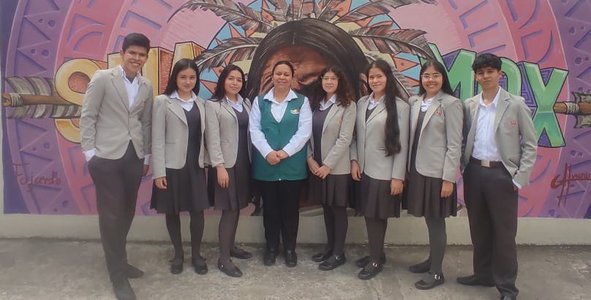
Curiosity CEDHU has received the following awards and nominations. Way to go!
We developed a robot called MEGH, a digital tool which is a web page and an analogous tool that is a board game. It solves the challenge by making NASA's information comprensible and accessible for children with age ranges among 10-15 years old no matter if the don't have a constant internet connection and MEGH help them understand how living beings behavior during space trips due to the terrarium in her inside . It is important because every child deserves to get to this information and not all children in educational institutions have constant internet connection and that doesn't allow them to get the information they want
To respond to the challenge, this project uses two different tools. We created a web page and a robot whose name is MEGH and has a terrarium inside. On the other hand, we made a board game as an analog instrument.
The project mainly does three things: First, with the robot that is going to be the super hero, we outline an idea of how space trips can affect biotic beings' natural processes. Then, the board game is a pedagogic tool for educational institutions that can give an approach to all sorts of NASA space trips information by means of challenges and questions. And lastly, a web page that is a complement for the board game and has additional information and tips about NASA data archives, as well as instructions for the board game.
The project has multiple benefits such as providing rural educational institutions the opportunity to acquire knowledge and information about space trips and biotic material consignment to space. Not all these institutions have constant internet connection and not all the children have enough economical resources to access NASA’s information and the project allows these children an approach to technological, modern and innovative ways to learn. Besides, the project looks forward to giving women visibility as a result of MEGH’s female personality and searching for more women and girls to participate in sciences.
What we hope to achieve is that children in age ranges between 10 to 15 years old from any kind of educational institution get and reinforce their knowledge regarding astronomy and space trips.
How does it work?:
Robot MEGH: MEGH is a female robot and she has a terrarium inside her heart that contains two distinct types of plants with different properties: First, a local plant from Boyacá which is called Nabo (Brassica rapa subsp. rapa) and has medical properties such as having a low calorie count, regulation of glycemic index, and having a short germination period. Additionally, the terrarium has succulent plants with properties such as the huge capacity to keep water and provide it to the Nabo plant (Brassica rapa subsp. rapa). MEGH’s colors are green, blue and white, but, What does every color represent? MEGH is a natural superheroine, she wants to give visibility to all living beings, her heart belongs to plant diversity that’s what color green symbolizes. White stands for NASA’s space shuttles and MEGH considered it as a substantial part of her body. Blue is her soul, blue is the calm water that travels among the plants, that refreshes and keeps MEGH cool.
MEGH has two control foci, with two different circuit systems.
First of all, the circuit in charge of transporting and caring for the terrarium, is made up of 6 geared motors controlled by a bridge h l293d that controls the axes of laterality as well as a radiofrequency system that controls remotely from the ground (approximately from Mars to the earth takes about 20 minutes to get a signal from the robot).In addition to an ultrasound sensor that will play the role of sight in an environment. A servo motor that will give visibility to the camera in 180 degrees.
For the second circuit that is located in the cube of the terrarium, there is the control and management system of the terrarium with several sensors such as the temperature and humidity sensor, in addition to the light control system.
The first phase deals with the transport and maintenance of the terrarium largely commissioned by the robot. The second phase is the process of collecting essential soil and air samples for future research missions.
MEGH is not a common robot, she is inspired by the different systems that some living beings that exist on our planet have, for example for the location system with ultrasound in bats that locate themselves in space thanks to these sounds, or the regulation system of temperature that snakes have and the humidity regulation system that plants make by themselves.
Web page: This web page’s objective is to describe MEGH’s features, objectives, the terrarium property and status before, during and after the trip, besides, it also has the purpose to detail and explain how the board game works and its respective instructions. Additionally, it has tips and information from NASA data archives which allow children from educational institutions to easily access that information. Nevertheless, we created a youtube channel (https://www.youtube.com/channel/UChL7XgVSvSdY3-mNUyhqmcQ) with explanatory videos about MEGH and information about plants processes, space trips, Challenge Based Learning, our board game and web page functioning.
Board game: Learn New things with MEGH: This board game contains 6 levels that are divided by 6 colors and is structured on missions NASA has done to arrive on Mars. It has 15 cards and includes 5 questions, 5 challenges and 5 bonuses. All the questions are related to NASA Missions and to the avatar the player is using at that moment, for example if the player is using the plant avatar, the questions are going to be associated with circadian cycle and biogeochemical processes. Then again, it has 4 avatars which are plant, robot, rocket and astronaut. The game starts with the plant and during the development of the game, the players acquire the other avatars with the bonuses. To reach the end it is necessary to have earned all the avatars (plant, robot, rocket and astronaut) and fulfill all the challenges. The game is designed for children from ages between 10 and 15 years old, due to the difficulty of the questions, these ones can be difficult for a kid under this age (10 year old) and can result straightforward for a person older than this age (15 year old). ..
The educational institutions that are going to be beneficiaries are rural educational institutions that lack a constant internet connection, don’t have access to NASA data files or do not have enough economical resources to consult or get information about space trips or any other NASA mission. Therefore, the tangible game is a great option for the learning process and it can be directly associated with a pedagogical strategy called Challenge Based Learning. “Challenge Based Learning is a pedagogy that has been incorporated in educational areas such as Science and Engineering, and demand a world real perspective because it suggests that learning implies students to do or to act regarding to a subject” Jou, Hung and Lai (2010) how was quoted in Tecnológico de Monterrey (2020). So, when students interact with tangible devices and have fun while learning concepts considered difficult, the acquiring knowledge process tends to be more pleasant.
The game is a perfect tool to implement Challenge Based Learning, because students must solve problems and have critical thinking but interacting with tangible devices, the game also has two key components, accordance with Apple these are essential questions and it consists on generating a wide variety of essential questions that should reflect the interests of the students and the needs of their community. Essential questions identify what is important to know about the big idea and refine and contextualize that idea. (Apple, 2008) The board game’s questions imply critical thinking and search out for ways to solve the problem. The other key component is the challenge and it consists in “From each essential question a challenge is articulated that asks students to create a specific answer or solution that can result in concrete, meaningful action” Apple, 2008 .p.2 These challenges allow students to explore ideas and to act looking for ways to solve the problem the challenge in the card implies.
That information was used to make the questions in the board game cards and as a guide to assembly, elaboration and to detail some robot's aspects to keep the terrarium plants safe during the space trip and to understand how does it behave and how the biological processes in living beings can be altered . The information was taken from NASA's data archive like human research roadmap, space biology program, 5 hazard of human spaceflight and genelab data repository. Aditionally, we used sorces from (CSA) Canadian Space Agency and it was Effects of space on the human body. Besides, it helped us to understand concepts we didn't know some aspects about. NASA's information was fundamental for developing this project and reach the objectives the challenged proposed
The Space Apps experience was just great, it was incredible and profitable. We learnt lots of things and concepts, for example how space trips are, the way living beings behave and how they biological processes can be altered, we learnt how to develop team work, lots of concepts we didn't know about, the importance of astronomy and NASA's missions and a new pedagogical method called Challenge Based Learning. We chose this challenge because of curiosity, passion for problem solving, love for innovative and modern things, and because of our great biology teacher. We focused on curious children to have the opportunity of learning about space trips and to get them closer to NASA's information and data no matter if they don't have constant internet connection. Our great attitude, desire to solve problem and innovate, our trust in our habilities and our love for making this world didn't let us give up. First and most important, we want to thank NASA for making this kind of events that let us expose our ideas, also, the public institutions in our city that supported us and finally, our great teachers who kept us motivated all the time.
Apple. (2008). Challenge Based Learning Take action and make a difference. https://www.apple.com/ca/education/docs/Apple-ChallengedBasedLearning.pdf
Bolles, D. (1 de octubre de 2022). Space Biology Program, Nasa Science. https://science.nasa.gov/biological-physical/programs/space-biology
Canva. (s.f). [Imagenes]. Canva. https://www.canva.com/design/DAFN1T-m74M/1bM_867lYyMXqc2jDho6_w/edit?utm_content=DAFN1T-m74M&utm_campaign=designshare&utm_medium=link2&utm_source=sharebutton
Canva. (s.f). [Imagenes]. Canva. https://www.canva.com/design/DAFNovVLMA0/aKH8uJHi9CG6AYPemS1lLA/edit?utm_content=DAFNovVLMA0&utm_campaign=designshare&utm_medium=link2&utm_source=sharebutton
Canva. (s.f). [Imagenes]. Canva. https://www.canva.com/design/DAFNzb61e8E/iUCli4j1OXYeWfUZqwXjhg/edit?utm_content=DAFNzb61e8E&utm_campaign=designshare&utm_medium=link2&utm_source=sharebutton
Catalyststuff. (s.f). Astronauta sentado en la nube con la ilustración de icono de vector de dibujos animados de globo de planeta. concepto de icono de tecnología de ciencia aislado vector premium. estilo de dibujos animados plana [Imagen]. Freepik. https://www.freepik.es/vector-premium/astronauta-sentado-nube-ilustracion-icono-vector-dibujos-animados-globo-planeta-concepto-icono-tecnologia-ciencia-aislado-vector-premium-estilo-dibujos-animados-plana_16306491.htm
Catalyststuff. (s.f). Astronauta sentado en la luna icono ilustración. personaje de dibujos animados de la mascota del astronauta. concepto de icono de ciencia aislado [Imagen]. Freepik. https://www.freepik.es/vector-premium/astronauta-sentado-luna-icono-ilustracion-personaje-dibujos-animados-mascota-astronauta-concepto-icono-ciencia-aislado_7529294.htm
Catalyststuff. (s.f). Lindo astronauta con estrella en la ilustración de icono de vector de dibujos animados de espacio. concepto de icono de ciencia de tecnología aislado vector premium. estilo de dibujos animados plana [Imagen]. Freepik. https://www.freepik.es/vector-gratis/lindo-astronauta-estrella-ilustracion-icono-vector-dibujos-animados-espacio-concepto-icono-ciencia-tecnologia-aislado-vector-premium-estilo-dibujos-animados-plana_20056939.htm
Catalyststuff. (s.f). Vector gratis lindo astronauta flotando con la ilustración de icono de vector de dibujos animados de globo ovni. concepto de icono de tecnología de ciencia aislado vector premium. estilo de dibujos animados plana [Imagen]. Freepik. https://www.freepik.es/vector-gratis/lindo-astronauta-flotando-ilustracion-icono-vector-dibujos-animados-globo-ovni-concepto-icono-tecnologia-ciencia-aislado-vector-premium-estilo-dibujos-animados-plana_20057005.htm#query=astronauta%20luna&position=5&from_view=keyword
Catalyststuff. (s.f). Vector gratis lindo astronauta cogiendo luna dibujos animados vector icono ilustración [Imagen]. Freepik. https://www.freepik.es/vector-gratis/lindo-astronauta-cogiendo-luna-dibujos-animados-vector-icono-ilustracion_16740735.htm#query=astronauta%20dibujo&position=1&from_view=keyword
Centro de Desarrollo Humano Cedhu [CEDHU] (s.f). Página web Centro de Desarrollo Humano CEDHU.CEDHU. https://www.cedhu.edu.co/
Centro Espacial Johnson de la NASA [National Aeronautics and Space Administration]. (8 de mayo de 2019). 5 Hazards of Human Spaceflight. NASA. https://www.nasa.gov/hrp/5-hazards-of-human-spaceflight
Dávalos, N. (14 de diciembre de 2020). Estos han sido los intentos del hombre por llegar a Marte. Primicias. https://www.primicias.ec/noticias/tecnologia/intentos-hombre-llegar-marte/
EcoDiario.es. (30 de noviembre de 2017). Marte: 10 preguntas básicas sobre el planeta rojo. elEconomista.es. https://ecodiario.eleconomista.es/viralplus/noticias/8781260/11/17/Marte-respondemos-10-preguntas-basicas-sobre-el-planeta-rojo.html
Ecorobotik (s.f). Las 5 partes esenciales de un robot que necesitas conocer. Ecorobotik. https://ecorobotik.com/es/blog/5-partes-esenciales-de-un-robot-que-necesitas-conocer
FondosMil. (s.f). Fondos de pantalla del espacio [Imagen]. FondosMil. https://fondosmil.com/espacio
Flaticon. (s.f). Planta en crecimiento icono gratis [Imagen]. Flaticon. https://www.flaticon.es/icono-gratis/planta-en-crecimiento_71199
Flaticon. (s.f). Nabo icono gratis [Imagen]. Flaticon. https://www.flaticon.es/icono-gratis/nabo_1147606
Genially. (s.f). [Imagenes]. Genially. https://app.genial.ly/editor/633849384287f60019b4ca66
Gil, I. (16 de mayo de 2013). ¿Cómo crecen las plantas en el espacio? BBC NEWS MUNDO. https://www.bbc.com/mundo/noticias/2013/05/130516_plantas_nasa_crecimiento_ig
Government of Canada (19 de marzo de 2021). Effects of space on the body. Government of Canada. https://www.asc-csa.gc.ca/eng/astronauts/space-medicine/concerns.asp
Government of Canada (18 de agosto de 2006). What is decompression sickness. Government of Canada? https://www.asc-csa.gc.ca/eng/astronauts/space-medicine/decomp.asp
Government of Canada (18 de agosto de 2006). What happens to muscles in space? Government of Canada. https://www.asc-csa.gc.ca/eng/astronauts/space-medicine/muscles.asp
Government of Canada (18 de agosto de 2006).How does radiation affect the human body in space? Government of Canada. https://www.asc-csa.gc.ca/eng/astronauts/space-medicine/radiation.asp
Greicius, T. (27 de enero de 2022). NASA’s MRO Finds Water Flowed on Mars Longer Than Previously Thought. NASA. https://www.nasa.gov/feature/jpl/nasa-s-mro-finds-water-flowed-on-mars-longer-than-previously-thought
Greicius, T. (17 de mayo de 2022). NASA’s InSight Still Hunting Marsquakes as Power Levels Diminish. NASA. https://www.nasa.gov/feature/jpl/nasa-s-insight-still-hunting-marsquakes-as-power-levels-diminish
Guzman, A. (24 de junio de 2021). Space Station Science Highlights: Week of June 14, 2021. NASA. https://www.nasa.gov/mission_pages/station/research/news/space-station-science-highlights-14jun21
Hartono, N. (22 de julio de 2021). NASA’s InSight Reveals the Deep Interior of Mars. NASA. https://www.nasa.gov/feature/jpl/nasa-s-insight-reveals-the-deep-interior-of-mars
Hipo Clips – Test Divertidos. (11 de noviembre de 2019). SISTEMA SOLAR ¿CUANTO SABES? [Archivo de vídeo]. YouTube. https://www.youtube.com/watch?app=desktop&v=dlHbH4APvfo&t=310s
Instituto Nacional de Técnica Aeroespacial [INTA] (2022). Agencias espaciales. INTA Descubre y Aprende. https://inta.es/descubre-y-aprende/es/Cienciateca/agencias-espaciales/
Investigación del INARE (20 de mayo de 2020). Plantas: sensibilidad a la gravedad les permite adaptarse y mantener posición vertical. Redagrícola. https://www.redagricola.com/cl/plantas-sensibilidad-a-la-gravedad-les-permite-adaptarse-y-mantener-posicion-vertical/#:~:text=Plantas%3A%20sensibilidad%20a%20la%20gravedad%20les%20permite%20adaptarse%20y%20mantener,si%20hay%20presencia%20de%20viento
Kjpargeter. (s.f). 3d space scene [Imagen]. Freepik. https://www.freepik.com/free-photo/3d-space-scene_1077125.htm#query=space&position=30&from_view=keyword
La Información (16 de octubre de 2017). El insomnio de los astronautas: cómo dormir cuando amanece 16 veces al día. La Información. https://www.lainformacion.com/asuntos-sociales/el-insomnio-de-los-astronautas-como-dormir-cuando-amanece-16-veces-al-dia_6zqfcdug4rz6fuvryz7ko2/
Lifeder. (27 de agosto de 2019). 100 Preguntas del SISTEMA SOLAR y sus Planetas ¿Cuánto Sabes del UNIVERSO?[Archivo de vídeo]. YouTube. https://www.youtube.com/watch?app=desktop&v=Ijze3ahkR_U&t=112s
Loopea. (2021). Inicializando array con lista de valores [Imagen]. Tinkercard. https://www.tinkercad.com/things/7TPjPegXc6j-inicializando-array-con-lista-de-valores
Madrid Deep Space Communications Complex [MDSCC]. (s.f). El orbitador Odyssey de la NASA cumple 20 históricos años de mapeo de Marte. Madrid Deep Space Communications Complex. https://www.mdscc.nasa.gov/index.php/2021/04/08/el-orbitador-odyssey-de-la-nasa-cumple-20-historicos-anos-de-mapeo-de-marte/
Martínez, B. (8 de enero de 2021). 27 divertidísimos retos en casa que son un desafío para niños y padres. guiainfantial.com. https://www.guiainfantil.com/ocio/juegos/27-divertidisimos-retos-en-casa-que-son-un-desafio-para-ninos-y-padres/
MedlinePlus (s.f). Dormir bien. MedlinePlus. https://medlineplus.gov/spanish/healthysleep.html
Molina, A. (2017). ¿Cómo regulan las plantas su reloj interno? Investigación y Ciencia. https://www.investigacionyciencia.es/noticias/cmo-regulan-las-plantas-su-reloj-interno-10007#:~:text=El%20ritmo%20circadiano%20se%20genera,independiente%20a%20peque%C3%B1as%20variaciones%20externas
“NASA”. Wikipedia, la enciclopedia libre. 2 de octubre de 2022. 1 de octubre de 2022. https://es.wikipedia.org/wiki/NASA
NASA [National Aeronautics and Space Administration] (s.f). Hoja de ruta de investigación humana. NASA. https://humanresearchroadmap.nasa.gov/risks/
NASANET (19 de febrero de 2020). La Sonda Espacial MRO de la NASA Actualiza su Memoria. NASANET. https://www.lanasa.net/misiones/marte/la-sonda-espacial-mro-de-la-nasa-actualiza-su-memoria#:~:text=MRO%20se%20lanz%C3%B3%20en%202005,da%C3%B1o%20de%20los%20rayos%20c%C3%B3smicos
NASANET (16 de junio de 2022). La Nave Espacial MAVEN Sale de Modo Seguro y Reanuda sus Operaciones. NASANET. https://www.lanasa.net/misiones/marte/la-nave-espacial-maven-sale-de-modo-seguro-y-reanuda-las-operaciones-cientificas#:~:text=MAVEN%20se%20lanz%C3%B3%20en%20Noviembre,atm%C3%B3sfera%20marciana%20hacia%20el%20espacio
Noun Project: Free Icons & Stock Photos for Everything. (2020). Board game [Imagen]. Noun Project: Free Icons & Stock Photos for Everything. https://thenounproject.com/icon/board-game-3978389/
Pixabay. (2014). Planeta rojo luna extraterrestre [Imagen]. Pixabay. https://pixabay.com/es/illustrations/planeta-rojo-luna-extraterrestre-571902/
Shutterstock. (s.f). Dibujo de la mano planeta tierra [Imagen]. Shutterstock. https://www.shutterstock.com/es/image-vector/planet-earth-hand-writing-cartoon-credit-116135071
Symborg. (2022). Tipos de estrés en las plantas Guía Básica Para Agricultores. Symborg. https://symborg.com/mx/tipos-de-estres-en-las-plantas-guia-basica-para-agricultores/#:~:text=La%20mayor%C3%ADa%20de%20las%20plantas,se%20congelan%20y%20terminan%20muriendo
Talbert, T. (31 de mayo de 2022). Update: NASA Extends Exploration for 8 Planetary Science Missions. NASA. https://www.nasa.gov/feature/update-nasa-extends-exploration-for-8-planetary-science-missions
Tecnológico de Monterrey (2015). Aprendizaje basado en retos. P. EduTrends. p.7. Recuperado de: https://observatorio.tec.mx/edutrendsabr
The European Space Agency [ESA] (19 de diciembre de 2003). Historia de la exploración de Marte. The European Space Agency. https://www.esa.int/Space_in_Member_States/Spain/Historia_de_la_exploracion_de_Marte#:~:text=La%20exploraci%C3%B3n%20de%20Marte%20se,marciana%20Phobos%3B%20y%20la%20estadounidense
Troytiño, I. (18 de mayo de 2022). La misión InSight a Marte se acerca a su fin porque sus paneles solares están cubiertos de polvo. La Vanguardia. https://www.lavanguardia.com/ciencia/20220518/8276205/mision-insight-marte-llega-paneles-solares-cubiertos-polvo.html
Univision (5 de abril de 2018). Estos son los 5 grandes objetivos de OSIRIS-Rex, la innovadora misión de la NASA al asteroide Bennu. Univision. https://www.univision.com/explora/estos-son-los-5-grandes-objetivos-de-osiris-rex-la-innovadora-mision-de-la-nasa-al-asteroide-bennu
Vexels. (2020). Ilustración del planeta marte [Imagen]. Vexels. https://es.vexels.com/png-svg/vista-previa/205472/ilustracion-de-planeta-marte
#biology, #terrarium, #boardgame, #robot, #webpage, #nature, #learn, #analogical, #digital, #ecology, #environment, #mars, #spacetrips
Space exploration involves overcoming numerous challenges: extreme gravity, disrupted sleep and circadian rhythms, limited supplies, and access to medical care, etc. Your challenge is to design a platform that allows users to explore space travel stresses, understand how diverse organisms deal with these stresses, and then build a “Space Biology Superhero” by combining features from these organisms.