
High-Level Project Summary
We developed a multi platform experience in which, through a playful learning approach, we offer the user the opportunity to get to know and understand the reach and appliances of certain NASA investigations, without it being too tedious for the average user to read in comparison to the traditional report format. This 8-bit styled video game will rely on storytelling to bring users closer to the information by putting the player in situations where they need to know the basics of some NASA's investigations, offered by the game itself, to apply it on mini games that will allow the user to continue their adventure. Instead of forcing the user to read, they will voluntarily inquire further.
Link to Final Project
Link to Project "Demo"
Detailed Project Description
We coordinate the informative part of the challenge with the interactive experience of the game.
The exploration of solutions in order to overcome physic limitations in the exploration of outter space.
Investigations for the development area, biology data, different outter space environments.
Our project main goal is to educate about the risks, oportunities and different case scenarios we can encounter in outter space.
Search for the capacities of different organisms and see how they are affected in space, but it is not just any organism, rather we base ourselves on those that have been taken for experiments in space and that in some way a part of them can withstand the tensions and pressures of it.
Based on this, we seek that people find out how these experiments are carried out and that they can see how it works and how it interacts when it is exposed in space through the digital platform that we present, which will be a video game in the one that presents various scenarios for the user to interact with them and manage to overcome the obstacles, at the same time it will be interactive but they will also be giving them learning about what is happening and why, our goal is to make it the most realistic possible.
Space Agency Data
For our Prototype, we heavily inspired our story on the radiation resistance qualities of mice (NASA GeneLab Project), and the various investigations about how possible is it to grow potatoes on outer space environments. This allowed us to create a story that moves through mini games that require the player to hold tiny bits of information about both subjects, and solve tasks with it.
Miller, J., Kidane, Y., Berrios, D., Gebre, S. G. & Costes, S. V. (2018, junio). NASA GeneLab Project: Bridging Space Radiation Omics with Ground Studies. Radiation Research, 189(6), 553-559. https://doi.org/10.1667/rr15062.1
M. Smith et al., "The Artemis Program: An Overview of NASA's Activities to Return Humans to the Moon," 2020 IEEE Aerospace Conference, 2020, pp. 1-10, doi: 10.1109/AERO47225.2020.9172323.
Rainey, K. (2019, 17 abril). Crew Members Sample Leafy Greens Grown on Space Station. NASA. Recuperado 2 de octubre de 2022, de https://www.nasa.gov/mission_pages/station/research/news/meals_ready_to_eat/
Hackathon Journey
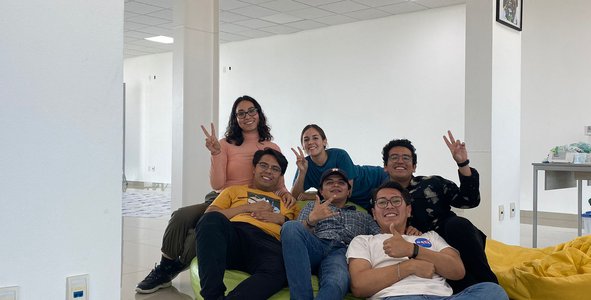
It was a very pleasant experience, when we started to assemble the team many people did not know what it was about and were doubtful but we were explaining what was happening in said event, what we could do and the
experiences.
At first we didn't know where to start, but then we began to classify the topics that we were going to deal with and the activities that we had to carry out. And we began to distribute roles to each one according to their abilities, and then we began to make the programs. The investigations, the design and then we put everything together so that we were working in parallel and we were detailing all together the things that we are doing from the information to the programs and we see sometimes we feel that we did not advance but after a long time and we see that there were results a very pleasant experience for all of us and that without a doubt that if we were to repeat
References
1-Page cannot be found - BBC News. (s. f.). Recuperado 1 de octubre de 2022, de https://www.bbc.com/mundo/noticias/2013/09/130510_ciencia_astronautas_marte_aa+https://datos.gob.mx/busca/dataset?theme=Geoespacial
2- 8 cosas que no sabías sobre las libélulas. (2021, 28 junio). FZAYAS.COM. Recuperado 1 de octubre de 2022, de https://www.fzayas.com/8-cosas-que-no-sabias-sobre-las-libelulas/
3- Marín, D. (2014, 15 febrero). La radiación en el espacio. Eureka. Recuperado 1 de octubre de 2022, de https://danielmarin.naukas.com/2011/03/23/la-radiacion-en-el-espacio/
4- Gil, J. (2018, 26 septiembre). Organismos que pueden sobrevivir a una catástrofe nuclear. MuyInteresante.es. Recuperado 1 de octubre de 2022, de https://www.muyinteresante.es/naturaleza/fotos/organismos-que-pueden-sobrevivir-a-una-catastrofe-nuclear#:%7E:text=Hablando%20en%20cifras%2C%20un%20ser,los%20ratones%20(9%20Gy).
5- O.Thomas, C. (2022, 30 julio). Macaco japonés: información y características. Mis Animales. Recuperado 1 de octubre de 2022, de https://misanimales.com/macaco-japones-informacion-y-caracteristicas/
6- Las habilidades sociales de los macacos están vinculadas a la variación de los genes del autismo. (2022, 1 abril). Misitio. Recuperado 1 de octubre de 2022, de https://www.autismovivo.org/post/las-habilidades-sociales-de-los-macacos-est%C3%A1n-vinculadas-a-la-variaci%C3%B3n-de-los-genes-del-autismo
7-BBC News Mundo. (2015, 31 marzo). La sorprendente capacidad de las hormigas ante la falta de gravedad. Recuperado 1 de octubre de 2022, de https://www.bbc.com/mundo/noticias/2015/03/150331_hormigas_gravedad_espacio_lp
7- Mundo, S. (2021, 11 febrero). Papas en el espacio: el proyecto gracias al cual podrás comer un puré cultivado en Marte. Sputnik Mundo. Recuperado 1 de octubre de 2022, de https://sputniknews.lat/20170311/papas-cultivos-marte-1067519379.html#:%7E:text=la%20papa%20(cip)-,Papas%20en%20el%20espacio%3A%20el%20proyecto%20gracias%20al%20cual%20podr%C3%A1s,un%20pur%C3%A9%20cultivado%20en%20Marte&text=S%C3%ADguenos%20en-,La%20NASA%20y%20el%20Centro%20Internacional%20de%20la%20Papa%20est%C3%A1n,en%20los%20suelos%20de%20Marte.
8- Aem, E. E. H.-. (s. f.). La Astrobiología: ejemplo de investigación multidisciplinaria. Hacia el espacio. Recuperado 1 de octubre de 2022, de https://haciaelespacio.aem.gob.mx/revistadigital/articul.php?interior=640
9- Investigaciones de la Estación: Analizando los factores estresantes de los vuelos espaciales | Ciencia de la NASA. (s. f.). Recuperado 1 de octubre de 2022, de https://ciencia.nasa.gov/investigaciones-de-la-estaci%C3%B3n-analizando-los-factores-estresantes-de-los-vuelos-espaciales
10- Cinco peligros del vuelo espacial humano. (2018, 14 agosto). UNAM Global. Recuperado 1 de octubre de 2022, de https://unamglobal.unam.mx/peligros-a-los-que-estaran-expuestos-astronautas-en-misiones-a-marte/
11- Fernández, J. S. (2022, 1 octubre). Página no encontrada. TecnoXplora. Recuperado 1 de octubre de 2022, de https://www.lasexta.com/tecnologia-tecnoxplora/ciencia/astronomia/esto-que-pasaria-
12- Page cannot be found - BBC News. (s. f.-b). Recuperado 1 de octubre de 2022, de https://www.bbc.com/mundo/noticias-49269225+
13- BBC News Mundo. (2016, 22 septiembre). El secreto del animal que puede vivir en las condiciones más extremas de la Tierra. Recuperado 1 de octubre de 2022, de https://www.bbc.com/mundo/media-37441048
14- Investigaciones de la Estación: Analizando los factores estresantes de los vuelos espaciales | Ciencia de la NASA. (s. f.-b). Recuperado 1 de octubre de 2022, de https://ciencia.nasa.gov/investigaciones-de-la-estaci%C3%B3n-analizando-los-factores-estresantes-de-los-vuelos-espaciales
15.- Miller, J., Kidane, Y., Berrios, D., Gebre, S. G. & Costes, S. V. (2018, junio). NASA GeneLab Project: Bridging Space Radiation Omics with Ground Studies. Radiation Research, 189(6), 553-559. https://doi.org/10.1667/rr15062.1
16.- M. Smith et al., "The Artemis Program: An Overview of NASA's Activities to Return Humans to the Moon," 2020 IEEE Aerospace Conference, 2020, pp. 1-10, doi: 10.1109/AERO47225.2020.9172323.
17.- Rainey, K. (2019, 17 abril). Crew Members Sample Leafy Greens Grown on Space Station. NASA. Recuperado 2 de octubre de 2022, de https://www.nasa.gov/mission_pages/station/research/news/meals_ready_to_eat/
Tags
#MX #STARLYNX #SPACE_BIOLOGY_SUPERHERO #J.U.A.N.2045 #NASA #GTO #SPACE_APP_CHALLENGE #2022 #VIDEOGAME #TECHNOLOGY #UNIVERSE #BIOLOGIA_ESPACIAL #RETO #VUELOS_ESPACIALES #GRAVEDAD #RADIACION