
High-Level Project Summary
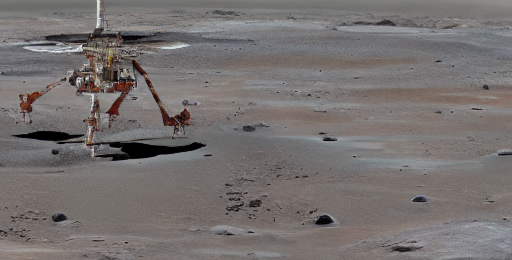
We developed a website as an interactive Martian Art platform for our creative Martian animations and images. We developed software code to create Martian arts by using advanced Machine Learning techniques and NASA open-data of Martian images from a research project HiRISE. We use Projected GAN (Generative Adversarial Network), Stable Diffusion, and Style Transfer to process large amounts of Martian images and create many unique Martian arts. Some of them combine science and culture. We demonstrated how to create Martian arts by combining Astronomy with Computer Science (AI/ML). We would like to share the Mars Exploration Program with the world in a creative way.
Link to Final Project
Link to Project "Demo"
Detailed Project Description
We use three Machine Learning Techniques to generate Martian Landscape, Future Martian Artwork, and Culture & Mars combined images. Specifically, we use large amounts of HiRISE images of Mars as a database to train our ML model with Projected GAN, output with generated images of Martian landscape. Stable Diffusion allows us to generate images from text prompts. Different prompts connect different images in the database and the computer organizes it together to a completely new artwork. Style Transfer is the technique that, given a content image and a style image, which we use culturally resembled content images and combine them with Martian styles. We use the Python language to develop the algorithms. For Stable Diffusion, the algorithm takes text prompts as inputs and generates corresponding art images. To facilitate image generating in a more efficient way, we also developed automatic ways to generate multiple images at one click. After we get our artwork generated, we create a website using Wix Webpage Builder. In there we displayed our generated images and gave brief introductions to how these images are created. We hope to build a platform that enables people to know our nearest neighbor planet: Mars, in a fun way. Also using the code we provide, they can generate their own images using their own computer. The website was divided into 7 pages: Home, a display of artwork and short introduction for each section; A Spanish version of Home, in order to reach out to diverse background audience; The “How we create” section includes detailed explanation for Machine Learning and each technique we used; HiRISE section include some scientific facts and introduction of NASA’s HiRISE Program and Mars. Our team member board displayed the name of our team members. The Art Gallery is a showplay for some of our best Generated Artworks. At last we created a Blog Area, in which we accept people from the world to train and generate their own images, which we would like to update frequently.
Space Agency Data
The space Agency data we used in our project are from NASA’s High Resolution Imaging Science Experiment. HiRISE is one of the six instruments onboard the Mars Reconnaissance Orbiter of NASA. What really inspired us by HiRISE images is that we are amazed by the very detailed and wonderful images taken from Mars. And we started to wonder, will we have a tour of the similar experience of our nearest neighbor planet Mars? We discovered HiRISE afterly. The high resolution images stunned us with its details given and how similar and different the geographical landscape on Mars is to the Earth, and we strongly desire to share these images to the world and let more people know their importance. For these reasons, we combine our techniques of Machine Learning to train and generate Martian art images by using these original images from NASA HiRISE. We use over a thousands of these HiRISE images in training with the Projected GAN ML programs, resulting in detailed enough images that hardt be distinguished from the real. We also use Style Transfer technique to give the well preserved human culture a style from Mars, using HiRISE images as Style Image. So that generates Martian arts with cultural factors embedded.
Hackathon Journey
I would describe our Space Apps experience as one of the most engaging events I had ever attended. As three high school girls, our team joined together by our common goal: to share science to the world. We have our team with people with diverse backgrounds and skills. So that our team members can support each other with unique skills and ideas. Also we are able to corporate smoothly and with high efficiency. We learned more of how a team really functions in a hackathon, and I learned how to manage and focus on one specific task for two full days. What inspired our team to choose this challenge is our eagerness to combine science with arts. All three of us are artists in different areas. We also are interested in computer sciences and other science areas. When we see this challenge, we know it is the thing we want to achieve all the time. In the first time, we were amazed by how our computer programs can generate so many wonderful artworks. From recrusing the team, we faced many obstacles such as time management, topic selection, dividing up the work to each team member, etc. Fortunately, we made it through as we know that communication is the number one priority when any problem occurs. I would like to thank the discord community of Space Apps Challenge, the discord community gathered users throughout the world.
References
NASA/JPL-Caltech/UArizona
https://mars.nasa.gov/mro/mission/instruments/hirise/
https://www.uahirise.org/epo/about/
https://mars.nasa.gov/all-about-mars/facts/
Wix.com
WikiArt
HuggingFace.co
DreamStudio.io
Google Slides
https://bestanimations.com/Earth&Space/Planets/Planets.html
https://www.asu.cas.cz/~bezdek/vyzkum/rotating_3d_globe/index.php
Tags
#computer science, #machine learning, #mars, #art, #nasa , #artificial intelligence