
High-Level Project Summary
"Weaving the cosmos" consists of the creation of Andean embroidery, inspired by the recent images obtained by the space exploration of the James Webb Telescope. It seeks to bring scientific advances closer to the native peoples, through the use of their own ancestral textile art. The importance of the "Weaving the Cosmos" project lies in the fact that, while promoting scientific understanding, it will allow the conservation and innovation of the local living culture of Cusco, Perú.
Link to Final Project
Link to Project "Demo"
Detailed Project Description
What exactly does it do?
"Weaving the Cosmos" brings closer, appealing to emotion, NASA's latest achievements with the space exploration of the James Webb Telescope, which has made it possible to observe more reliable images of the remote universe.
For ancient art, flora, fauna and nearby stars were the themes and motifs that constituted an enormous cultural legacy. Today, with the increasing technological advances in space exploration, the James Webb telescope has made it possible to identify the origin and formation of stars and galaxies by recording information from infrared wavelengths.
With a commitment to open science and public understanding of science, NASA attributed mathematically distributed colors to the images obtained. This was the first inclusion of art in the process of disseminating scientific results. In this regard, the textile art of the Asociación de Artesanas Grupo Margaritas de Marangani (Cusco, Peru), with its cultural tradition and commitment to innovation, brings Andean embroidery with astronomical content to solve the challenge of effectively including art in STEM, so that it can contribute to reducing the gaps in access to science education among indigenous peoples.
How does it work?
We begin by examining the open databank on the NASA website. In particular, we are interested in the first images taken by the James Webb Telescope (https://www.nasa.gov/webbfirstimages), as well as the final design of the telescope once it was in orbit.
Stephan's Quintet
The images of the Telescope, being a public data that summarizes the fascinating complexity between science, mathematics and physics in beautiful photos that excite and arouse the curiosity of people; in this case, the Cusquenian craftswomen, willing to bring the magic of the universe to an embroidery.

The images of the Telescope, being a public data that summarizes the fascinating complexity between science, mathematics and physics in beautiful photos that excite and arouse the curiosity of people; in this case, that of the Cusquenian craftswomen, willing to bring the magic of the universe to an embroidery.
Starting with a design, they draw by hand with pencil and paper, the interpretation of this new discovered universe: a star could be represented in a vicuña? or a galaxy could be represented in a snake? of course! because their creativity allows them to revive the meaning of the Andean culture based in Cusco.
From Andean embroidery, expressed in different accessories of daily use such as: clothing (coats, shirts, shawls), blankets, pencil cases, laptop cases, cases, among an endless number of objects;
It will constitute a vehicle of emotional stimulus for the scientific understanding of the open data provided by NASA.
Next, a guide paper is used to ensure the embroidery of the motifs chosen from NASA's open data. Next, the embroidery is done with the manual machine technique.
What are the benefits?
As a main benefit, we hope that "Weaving the Cosmos" will contribute to the scientific dissemination of NASA's open data, contributing to the reduction of gaps in science education and stimulating public understanding of space science and technology.
Another benefit of the "Weaving the Cosmos" project is the promotion, conservation and innovation of Andean ancestral textile art, thus promoting and revaluing its cultural production, because art can bring about an emotional and, therefore, long-lasting rapprochement.
What do you hope to achieve?
Although it seems that the progress of astronomy as a science, has moved away in its impact on our daily lives, astronomy continues to cause great interest and allowing us incredible technological developments, whose progress is not fully known because the media for scientific dissemination does not reach the masses. In this sense, we believe that art becomes a great tool for scientific popularization; since its reach is massive, and above all, art handles a lot of emotion, and emotion is a powerful tool for education to have new levels of reach, allowing abstract concepts to be easier to internalize.
For this reason, the greatest achievement we seek is to reduce the gaps in access to NASA's open data in the native peoples of Peru and rescuing their living culture.
What tools, coding languages, hardware or software did you use to develop your project?
- James Webb Telescope Image Gallery, July 2022
- Textile art composition process
- Sketchbook
- Colored pencils
- Bare paper
- Traditional wool
- Colored threads
- Hand embroidery machines
- Thread cutters
- Scissors
Space Agency Data
For the project, we used the following images from the James Webb Telescope provided by the NASA space agency; the same ones that served as inspiration for the creation of the Andean embroideries:
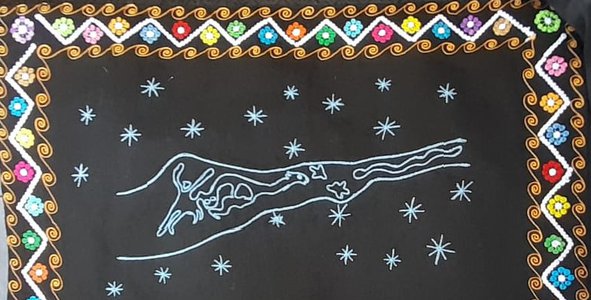
Stephan's Quintet: Stephan's 5 galaxies motivated its representation in the Andean animals of Cusco whose cultural significance has transcended several generations such as:
- The largest nebula located at the top, is represented by a vicuna that has the galaxy in the belly making reference to the fact that the energy is inside the living beings. The shape of the vicuna with the elongated leg is made more noticeable in the whiter section of our reference image.
- The 2 closest galaxies represent the 2 eyes of the puma that has its paws forward in a position of observation, with a thin stomach and culminates in the tail that is smaller. The puma is the most representative animal and denotes strength, teamwork; according to the stories, they always walked in herds and were characterized by survival. Its eyes, like the Andean cat, shine at night, giving a luminous touch to the design.
- With the nebula on the left side, he is represented with a toad. That in our Andean culture is the pachamama or mother earth, which is the one in the womb also represents the living being.
- The last nebula takes the form of a snake known as Amaru whose Inca meaning is wisdom, knowledge. To this art, forms are added with the stars that allude to the universe, in addition we give a representation of sliding; in the head is located the nebula that symbolizes the knowledge governed by the intellect.
Carina Nebula: In Cusco, the population of alpacas and vicuñas stands out for the fiber, texture and softness of their fur. These animals play with each other and when they turn around in the grass, pieces of dry grass (known locally as "pijas") get tangled in their wool. When their wool is worked and spread out, the pijas give the representation of the stars of the Carina Nebula.
James Webb Telescope: Since, as an artifact, it has made possible the visualization of the nebula, the planet WASP-96 b, among other contributions that allow us to know more about the universe.
We use the image of this artifact in a dynamic way, showing its essence, its characteristics so that it can be internalized by the general public and know how a space telescope works; and be amazed at how in a universe so vast and dark it is possible to capture images for example, of the southern ring nebula and reflect 2 stars that were not known before and now they are.
As for the colors of the animals, they are reflected with a color locally called "cusqueño red"; very representative of Cusco that resembles the dark tone of the universe. In combination with gold, which is the sun, our Inti to indicate the luminous and brilliant; and black, which is the color of purity in the Andean culture.
Hackathon Journey
How would you describe your Space Apps experience? What did you learn?
Participating in this Hackathon has been one of the few experiences that someone can share with friends and family and not be excited to talk about it.
If we summarize what we learned, first of all we mention the work in multidisciplinary teams; bringing together engineers, astronomers, designers, sociologists was very enriching and of great value for everyone. Also, the challenge to land an abstract idea that could stand out with the expectations of the event; since in our case we did not use code as a programming language, but the scientific and technological advances of NASA.
What inspired your team to choose this challenge?
In addition, we were immensely excited that Cusco was hosting the event, this inspired us to think about its cultural legacy and to seek to highlight traditions that have transcended different generations. In Marangani, Cusco; we had the contacts of textile artists who know detailed embroidery techniques, with this specific contribution as a support, we could unite it with art and together be a vehicle for dissemination of the results of the images of the James Webb telescope. Therefore, as a team we accepted the challenge "Turning STEM into STEAM"; in which we employed resources, interests and our experience with the incorporation of the arts.
What was your approach to developing this project?
Regarding our approach, we kept very much in mind a focus on scientific culture and public communication of science. In this way we were able to align our proposal to what was expected by the challenge, taking into account certain terms that the organization had defined, such as outreach, culture, among others.
How did your team resolve setbacks and challenges?
Working as a team from different parts of Peru, it was necessary to reinforce constant communication and show flexibility in the face of any changes. As a team we managed it by understanding internal needs, making short schedules and delegating project activities.
Is there anyone you'd like to thank and why?
To the Asociación de Artesanas Grupo Margaritas de Marangani (Cusco, Perú), for accepting the challenge of transmitting their art in the project. In addition to their great commitment and dedication in teaching us about embroidery and its interpretations.
References
- Foto James Webb - NASA: https://www.nasa.gov/webbfirstimages
- Recorded of Amauta: https://amautas.com/conversaciones-en-el-horizonte-2022/
- James Webb Deploy: https://youtu.be/3jT_Zui1Am8
- Facebook de Asociación de artesanas Margaritas de Marangani (Cusco, Perú): https://web.facebook.com/Margaritasdemarangani
- Video recordings of the craftswomen of the "Margarita" Community of Maranganí, Cusco.
Tags
#Art ,#Culture, #STEM, #STEAM, #Diversity, #Cusco, #Communication #Handcraft