
High-Level Project Summary
The project that was developed started from the challenge for the James Webb telescope, which sought to spread the discoveries and images that the telescope provided. In addition, to demonstrate that this new project has a higher resolution and quality in its productions. The objective of this project, in addition to solving the problem, was scientific dissemination in young minds. This given that the current information on scientific issues is doubtful and sometimes difficult to understand.
Link to Final Project
Link to Project "Demo"
Detailed Project Description
This project is a web-game which allows us to get involved in areas such as aerospace engineering, astrophysics and astronomy in a simple and creative way, allowing us to learn more about James Webb and Hubble telescopes.
For the programming part of the interactive web, it was created in the Visual Studio Code IDE with the Live Server extension, with the help of a common markup language called HTML, the page design was edited with CSS.
For the design process it was carried out in 3 programs. The creation of both telescopes in their different phases of "evolution", both James Webb and Hubble were made in illustrator, as well as other elements of the game that needed illustration. These illustrations were made from scratch based on NASA photos, Photoshop was also used for image editing, color correction and other layouts and mockups that were used for implementation on the website. Finally, Premier was used to edit the project presentation video, but also to animate other elements of the web page.
Space Agency Data
Open data was extracted from the NASA website for the project, using and verifying the information in different parts within the database, images obtained from the same platform were also used.
*HUBBLE.- In 1609, visionary Italian scientist Galileo Galilei turned the newly invented optical device of his day the telescopeto view the heavens. His observations conclusively showed that there were celestial bodies (the moons of Jupiter) that did not revolve around the Earth, launching a revolution that forever changed our view of an Earth-centered universe. Almost four centuries later, the launch of NASA’s Hubble Space Telescope aboard the Space Shuttle Discovery in 1990 started another revolution in astronomy.
This vantage point allows Hubble to observe astronomical objects and phenomena more consistently and with better detail than generally attainable from ground-based observatories. The telescope’s sensitive cameras and spectrographs can view objects as nearby and small as the collision of asteroids to distant star-forming galaxies that date back to when the universe was only three percent of its current age. In fact, Hubble observations have played a key role in discovering and characterizing the mysterious dark energy that appears to permeate space.
Horsehead Nebula.- Rising from a sea of dust and gas like a giant seahorse, the Horsehead nebula is one of the most photographed objects in the sky. NASA's Hubble Space Telescope took a close-up look at this heavenly icon, revealing the cloud's intricate structure. This detailed view of the horse's head is being released to celebrate the orbiting observatory's eleventh anniversary. Produced by the Hubble Heritage Project, this picture is a testament to the Horsehead's popularity.
The Horsehead, also known as Barnard 33, is a cold, dark cloud of gas and dust, silhouetted against the bright nebula, IC 434

Veil nebula.- Delicate in appearance, these filaments of shocked, glowing gas, draped in planet Earth's sky toward the constellation of Cygnus, make up the Veil Nebula. The nebula is a large supernova remnant, an expanding cloud born of the death explosion of a massive star. Light from the original supernova explosion likely reached Earth over 5,000 years ago. Also known as the Cygnus Loop, the Veil Nebula now spans nearly 3 degrees or about 6 times the diameter of the full Moon.

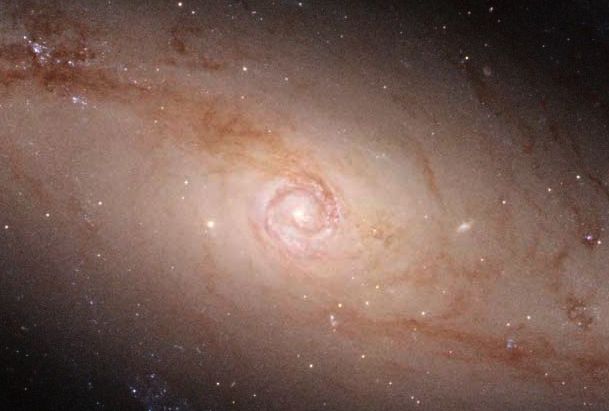
Barred Spiral Galaxy NGC 1300.- Big, beautiful, barred spiral galaxy NGC 1300 lies some 70 million light-years away on the banks of the constellation Eridanus. This Hubble Space Telescope composite view of the gorgeous island universe is one of the largest Hubble images ever made of a complete galaxy. NGC 1300 spans over 100,000 light-years and the Hubble image reveals striking details of the galaxy's dominant central bar and majestic spiral arms. In fact, on close inspection the nucleus of this classic barred spiral itself shows a remarkable region of spiral structure about 3,000 light-years across. Unlike other spiral galaxies, including our own Milky Way, NGC 1300 is not presently known to have a massive central black hole.

JAMES WEBB.- The James Webb Space Telescope is the world's largest and most powerful space telescope, focusing on infrared light, a low-frequency spectrum that will shed clues to the far reaches of the universe.
The James Webb Space Telescope was launched on Christmas Day 2021, its construction took 40 million hours, that is, 32 years of work.
Located approximately 1.5 million kilometers from our planet.
It is formed by a series of hexagonal mirrors that capture the light of the universe and distribute it to the different scientific instruments.
Tarantula nebula.-Near the center of a nearby star-forming region lies a massive cluster containing some of the largest and hottest stars known. Collectively known as star cluster NGC 2070, these stars are part of the vast Tarantula Nebula and were captured in two kinds of infrared light by the new Webb Space Telescope.

Southern Ring nebula.- The dimmer star at the center of this scene has been sending out rings of gas and dust for thousands of years in all directions, and NASA’s James Webb Space Telescope has revealed for the first time that this star is cloaked in dust.

Two cameras aboard Webb captured the latest image of this planetary nebula, cataloged as NGC 3132, and known inresearchers refine their knowledge of these objectsformally as the Southern Ring Nebula. It is approximately 2,500 light-years away.
Webb will allow astronomers to dig into many more specifics about planetary nebulae like this one – clouds of gas and dust expelled by dying stars.
SMACS 0723.- Massive foreground galaxy clusters magnify and distort the light of objects behind them, permitting a deep field view into both the extremely distant and intrinsically faint galaxy populations.
NASA’s James Webb Space Telescope has delivered the deepest and sharpest infrared image of the distant universe so far. Webb’s First Deep Field is galaxy cluster SMACS 0723, and it is teeming with thousands of galaxies – including the faintest objects ever observed in the infrared.
Webb’s image is approximately the size of a grain of sand held at arm’s length, a tiny sliver of the vast universe. The combined mass of this galaxy cluster acts as a gravitational lens, magnifying more distant galaxies, including some seen when the universe was less than a billion years old.

Carina nebula.-

Previously unseen details of a mysterious, complex structure within the Carina Nebula (NGC 3372) are revealed by this image of the "Keyhole Nebula," obtained with NASA's Hubble Space Telescope. The picture is a montage assembled from four different April 1999 telescope pointings with Hubble's Wide Field Planetary Camera 2, which used six different color filters.
The picture is dominated by a large, approximately circular feature, which is part of the Keyhole Nebula, named in the 19th century by Sir John Herschel. This region, about 8000 light-years from Earth, is located adjacent to the famous explosive variable star Eta Carinae, which lies just outside the field of view toward the upper right. The Carina Nebula also contains several other stars that are among the hottest and most massive known, each about 10 times as hot, and 100 times as massive, as our Sun.
Stephan’s Quintet.-The Webb telescope's capabilities bring new eyes to a cluster of galaxies first discovered in 1877 and known as Stephan’s Quintet. On display in this sharp new image are regions of new star birth containing millions of young stars as well as tails of gas, dust, and stars being ripped from galaxies as a result of gravitational forces between the galaxies.
Stephan’s Quintet is a dense cluster of galaxies located 290 million light-years away in the constellation Pegasus. Four of the five galaxies within the quintet are locked in orbits that repeatedly bring them close to one another. The fifth (leftmost) galaxy is seven times closer to Earth than the others. But its location within the line of sight of the distant four makes it appear to be grouped with them. What looks like speckles surrounding the nearby galaxy and could be mistaken for digital noise is actually individual stars from that galaxy.

JUPITER.- With giant storms, powerful winds, auroras, and extreme temperature and pressure conditions, Jupiter has a lot going on. Now, NASA’s James Webb Space Telescope has captured new images of the planet. Webb’s Jupiter observations will give scientists even more clues to Jupiter’s inner life.

Neptune
NASA's James Webb Space Telescope shows its capabilities closer to home with its first image of Neptune. Not only has Webb captured the clearest view of this distant planet's rings in more than 30 years, but his cameras reveal the ice giant from a whole new ve.

Hackathon Journey
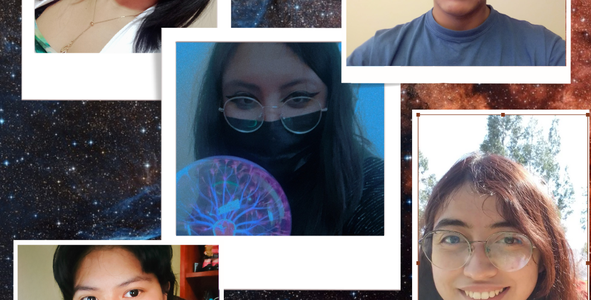
It was a challenging but very enriching experience. As a team we knew how to adapt to a schedule, to a certain extent, extreme but with organization we knew how to manage it. The chosen challenge was based on both the interests and the skills of each of the participants. This is how each one had an important role to complete the challenge. Our approach was based on the versatility and tendencies of today's young people in the matter of the attention they pay to the information they receive. We suffered some setbacks, especially in the programming part, but without hesitation we devised solutions or alternatives to solve our problems. As a team we would like to thank the local organizers and mentors who were with us every step of the way.
References
- APOD: 2008 June 22 - Barred spiral galaxy NGC 1300. (n.d.). Astronomy Picture of the Day. https://apod.nasa.gov/apod/ap080622.html
- APOD: 2010 September 16 - The veil nebula. (n.d.). Astronomy Picture of the Day. https://apod.nasa.gov/apod/ap100916.html
- Exoplanet-catalog – Exoplanet exploration: Planets beyond our solar system. (n.d.). Exoplanet Exploration: Planets Beyond our Solar System. https://exoplanets.nasa.gov/exoplanet-catalog/7220/hip-65426-b/
- HTML: Lenguaje de etiquetas de hipertexto | MDN. (2022, 4). MDN Web Docs. https://developer.mozilla.org/es/docs/Web/HTML
- Https://www.jpl.nasa.gov/. (2000, February 3). Light and shadow in the Carina nebula. NASA Jet Propulsion Laboratory (JPL). https://www.jpl.nasa.gov/images/pia14444-light-and-shadow-in-the-carina-nebula
- James Webb, el telescopio espacial Que estudia los secretos del universo. (n.d.). National Geographic. https://www.nationalgeographic.com.es/ciencia/james-webb-telescopio-espacial-que-estudia-secretos-universo_17668
- Las grandes diferencias entre las imágenes tomadas POR los telescopios Webb Y Hubble en el mismo Lugar del universo. (2022, July 12). BBC News Mundo. https://www.bbc.com/mundo/noticias-62137077
- NASA shares list of cosmic targets for Webb telescope’s 1st images. (2022, July 8). NASA. https://www.nasa.gov/feature/goddard/2022/nasa-shares-list-of-cosmic-targets-for-webb-telescope-s-first-images
- NASA updates coverage for Webb telescope’s first images reveal. (2022, July 7). NASA. https://www.nasa.gov/press-release/nasa-updates-coverage-for-webb-telescope-s-first-images-reveal/
- NASA’s Webb delivers deepest infrared image of universe yet. (2022, July 11). NASA. https://www.nasa.gov/image-feature/goddard/2022/nasa-s-webb-delivers-deepest-infrared-image-of-universe-yet/
- NASA’s Webb reveals cosmic cliffs, glittering landscape of star birth. (2022, July 11). NASA. https://www.nasa.gov/image-feature/goddard/2022/nasa-s-webb-reveals-cosmic-cliffs-glittering-landscape-of-star-birth/
- New Webb image captures clearest view of Neptune’s rings in decades. (2022, September 19). NASA. https://www.nasa.gov/feature/goddard/2022/new-webb-image-captures-clearest-view-of-neptune-s-rings-in-decades
Tags
#Telescope #JamesWebb #Hubble #Mirror