Awards & Nominations
Redshift has received the following awards and nominations. Way to go!
Global Nominee

Redshift has received the following awards and nominations. Way to go!
Space systems engineering is surely a very complex one. Thus, it requires innovative solutions to teach the science involved in it to the students. Our purpose in this challenge has been to develop a very attractive and easy-to-navigate 3D environment that renders the various parameters and capabilities of NASA's James Webb Space Telescope. There is even an interactive quiz to gain precise insight into the device and the challenges overcome in the development process while achieving a greater appreciation of the science. We have utilized existing game development tools like Unreal Engine and Blender in the development of the game.
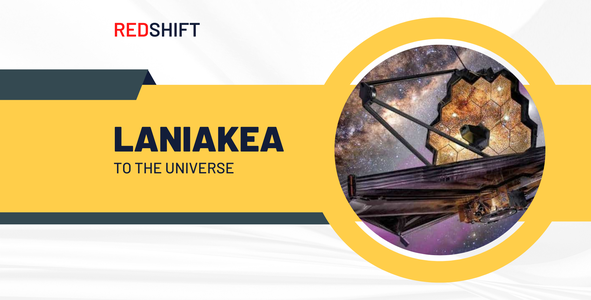
Welcome to the NASA Space Apps Challenge 2022. We are team Redshift, participating in the challenge "LEARNING THROUGH THE LOOKING GLASS". Our project "Laniakea", a game developed in Unreal Engine, exhibits the amazing capabilities of NASA's James Webb Space Telescope by showing its features and the incredible engineering behind them in an easy-to-understand 3D environment with photo-explanatory and audio support.

Image 1: The 3D exploration environment of the JWST
We don't know how the universe, its planets, stars, or the Earth came to be. We only know that the Big Bang occurred. The universe had three essential components back then. hydrogen, helium, and small amounts of lithium. Oxygen and water are two examples of goods for later life. through the nuclear processes that have occurred at the core of the star at various times. The James Webb Telescope will show us how much of the universe was created in the aftermath of the Big Bang. The name "Dark Matter" is another thing they can obtain here. The greatest thing we have any idea about is dark matter. Simply said, "dark matters" are the things you can't accomplish on the test and the things you don't know about. Similarly, scientists have given the label "dark matter" to entities in the cosmos that are not understood. According to NASA data, dark matter makes up about 27% of the total universe. If there is any disturbance from gravitational waves, the James-Webb Telescope can prove very clearly that there is dark matter in this location. And our game will help people learn about the James Webb Space Telescope's amazing capabilities and how it performs in space.
It also has an interactive quiz section with several difficulty levels to gain accurate parameters of the device. We believe our game could be useful for educators and enthusiasts to test various aspects of the science involved in the development of the telescope. We've collected the necessary information from NASA's website.

Image 2: Interactive multiple-choice quiz
According to NASA's website, new technologies are being created to aid in the construction of the James Webb Telescope. The biggest main mirror in the world has been mounted on the James Webb Telescope, as has the largest sun shield. It is also the world's most powerful telescope. It has a five-layer sun shield. Because the lowest portion is continually exposed to the light, it will become hotter. It can reach temperatures of around 358 kelvin, and each of its layers has a temperature that gradually drops. Finally, the topside must be cryogenic in temperature. At cryogenic temperatures, the molecules inside an item appear to be considerably colder and no longer moving. This temperature is kept at 40 degrees Kelvin. This is said to be the most complicated deployment of a single space mission.
We know the whole universe is expanding. Everything is gradually drifting apart from one another. Similarly, this expansion is caused by the light being thinner or having shorter wavelengths. When it reaches us, the light will become thicker, or the wavelength will increase due to the huge distance. The question is, what is the issue if the wavelength is quite long? Visible light has a wavelength that runs from 400 to 700 nanometers. By increasing the wavelength, this will now be more than 700 nanometers. It is then outside the visible light spectrum. It then collides with the infrared ray. So you can see why infrared has been utilized for so long. The reason is that the light that will emanate from the stars or galaxies that existed at the beginning of creation cannot be seen with the naked eye. They will appear in the form of infrared, and you will want a good instrument like the James Webb Telescope to catch them. and which we are seeing here.
We used Blender software to design raw assets for our environment and exported these to Unreal Engine, where we added functionality and logic through visual scripting with the help of "Blueprint".

Image 3: Behind the Scenes Logic (Blueprint) of the Quiz Questions
We believe that if properly utilized, this game will have a great impact on children in elementary schools, developing an interest in space systems engineering and astronomy and achieving a greater appreciation of the technology. This could prove to be very useful in the flourishing of education, especially in underdeveloped countries.
Image Galleries/Webb NASA: Detailed data & images of the Gems Webb Telescope.
Mid-Infrared Instrument Operations Update: for learning the four observing modes of The James Webb Space Telescope’s MIRI.
James Webb Space Telescope - NASA 3D Resources:Interact with this 3D model of the James Webb Space Telescope and to explore all the different parts of it.
Dark Energy Changes the Universe - NASA:Dark energy related information for JWST.
ESA James Webb Space Telescope website: Taken Images that JWST captured.
At the beginning of the universe, no light could escape through the dense opaque fog of primordial gas, but as the atomic particles began to cool down, hydrogen atoms began to form. This led to the universe's first few stars burning through the fog that once blocked the light from escaping the expanding universe. These early photons have travelled unhindered for 13.5 billion years through the vast empty expanse of space and will reach their destination on the man-made detectors of the James Webb telescope.
We are enthusiasts who believe that continuous improvement in technology and innovation must go on. The James Webb telescope is undoubtedly one of the most fascinating systems ever dreamt of, and we wish to unravel the complex engineering behind it. This is our first time participating in the NASA Space Apps Challenge, and we are very glad to be a part of it.
We highly appreciate BASIS for hosting the Space Apps Bangladesh round and their amazing mentorship and support throughout the project.
#laniakea, #redshift, #spaceappschallenge, #jwst, #LearningthroughtheLookingGlass