
High-Level Project Summary
We developed an android app called "Luminous" which will be used as a tool to spread the stellar variability to common human knowledge and bring a view of the vast dynamic sky into the palm of our hands with an easy access. As the changes in stars are too faint for the human eye, our app will use time lapse features which will allow the user to adjust the time scale & watch the stars evolve around time. Even though there are many people with the interest of studying stellar variability, the complicated arrangements of resources tends to drive them away. We included several interactive features including quizzes and live star navigation to make the app more attractive and fun way of learning.
Link to Final Project
Link to Project "Demo"
Detailed Project Description
Luminous is basically an android app that uses data from several open sources in order to be a complete package of everything a person needs to learn about stellar variability. Our app starts with an interactive launch button redirecting to the main navigation page - here the users can get the data of the stars right above them and control the time scale to understand and learn how those stars have evolved. After an user has completed the navigation, they can take a quiz about those stars to test their knowledge. The app has a communication tab where the users will be able to connect with others and discuss about the stars while also sharing information.
The main benefit of this app is that it is a combination of everything needed to learn. The fun, interactive features make the users learn more effectively as there's always something to keep them engaged. Thus there's a higher success rate.
With the help of our app, we hope to achieve our goal of making a "stellar-aware" society. When regular people will learn about stellar variability, they will have better understanding about the space and how things work over there. The users will have a good understanding about the researches being conducted by astronomers; they may also come up with new ideas which might later on turn into a great discoveries. Moreover, by being "stellar-aware" , the society will encourage younger generation to study about the space. Whilst many students nowadays are curious to learn more about space, there's no specific source where they are are being provided with everything in a simple way. Therefore, Luminous will be the first ever grouped source providing it all. Once the knowledge about stellar variability have been spread throughout the nations and the success rate is at it's peak, our mission will be accomplished.
For building this app, we used flutter and framework for tools. The languages that have been used are, dart, JavaScript, html and css. We used LDE- Android studio and API check-postman softwares to complete the project.
Space Agency Data
Our project idea required a large number of data source. One of the main data source we used was NASA solar system. We used the data to create a 3D model of the solar system so that our users can have realistic and authentic experience. The users will use the model to understand where the planets are and why planets look like stars from Earth. Apart from that, the Kepler Space Telescope data was the greatest inspiration for our project. We developed this idea from the data of those satellite.
To create the star navigation feature, we used an open data source called Stellarium which was initially arranged using the data from several space agencies and satellites like the Transiting Exoplanet Survey Satellite. In our project, we included a few space games which was developed using the logical methods collected from different space agencies all over the world.The images and animations we included in the app are taken from satellites such as Hubble Space Telescope.
We have used the European Space Agency data to create the 3D sky map which is also one of the most important section in our app. The catalogue of the stars have been collected from the BRITE Constellation database which is a combined satellite project by the Canadian Space agency. Therefore, our project was made out of many space agency data which helped us bring together the perfect stellar variability learning tool and thus develop the app "Luminous".
We can say that we collected most our data from:
- NASA
- ESA
- CSA
So, we can also say that - data from the space agencies are the most important resource of our project.
Hackathon Journey
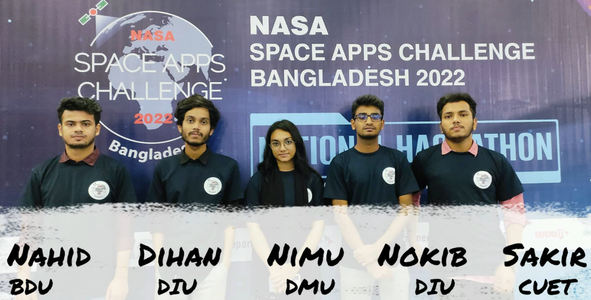
We first participated in spaceapp challenge back in 2020. We have been holding onto our passion about space study and this is what brought us together as Gryffindor 5 this year. We all worked together as one, helped and supported the group and successful built our project according to everyone's vision. There were times when we had to search a lot for resources and make changes in our plans. However working together really helped us to continue putting in efforts till we were satisfied with the end result. We would like to thank NASA for arranging the Hackathon every year as this is what brought the team up in the first place and because of which we were able to gain so many experiences.
References
- Stellarium
- NASA-solar system
- NASA-Star Child
- NASA-Imagine Gsfc
- Game verse neo gravity game
- Viewspace.org-variable-stars
- Viewspace.org-specteum of star altair
- https://www.cosmos.esa.int/web/gaia/
- https://sci.esa.int/web/hubble/
- https://www.asc-csa.gc.ca/
- https://donnees-data.asc-csa.gc.ca/dataset
Tags
#space #stars #stellar #stellarvariability #spaceapp2022 #android #solarsystem #nasa #luminous #education_stellar #stellar_learn #stellar_game #stellar_variability_learning_tool #stellar_variability #dynamic_night_sky