Awards & Nominations
Team Icarus has received the following awards and nominations. Way to go!
Global Nominee

Team Icarus has received the following awards and nominations. Way to go!
To enlighten the audience about Parker Solar Probe’s mission - we're addressing the challenge “On the Way to the Sun”, by developing a mixed reality video game, so that user can experience the Parker Solar Probe's entire journey from Earth to the solar atmosphere. This experience includes various virtual scenes regarding the Solar Probe, Sun’s atmosphere, the perils it faced, etc. The user can inspect the probe, play around with its orbit, and interact with the system as assisted using a fully voice-acted virtual assistant, Lee. Finally, we incorporated Virtual Reality into this experience to make it as compelling, immersive and captivating as possible.
Parker Solar Probe was the first human made object to “touch” the sun. Parker Solar Probe is one of the greatest scientific landmarks of history. After the moon landing in 1969, touching the sun was the most revolutionary achievement of NASA. It opened many doors about the mysteries of the sun’s atmosphere such as, why is the corona much hotter than the Sun's surface? The Solar Probe has collected and is still collecting enormous amounts of useful data about the sun and its surroundings.
It is impossible for any human being to get anywhere close to the sun. So, our project is to develop an experience of Parker Solar Probe’s journey towards the sun. Anyone can experience the journey from the beginning to the end without actually being in the space craft. The user will be enlightened with a variety of information about the whole journey.
At first we designed the game from a high-level overview. We planned the sequence of the game levels such as Rocket Launching, Trajectory Setting, Venus Flyby, Death Plunge etc. Then we added details to our levels.
We used NASA provided 3d models in our game. First of all, we imported the Parker Solar Probe model in our Trajectory Setting stage, Venus Flyby stage, and in the Death Plunge stage. In the death plunge stage, we successfully simulated the destruction of the solar probe model. We also used the model of the Sun and Venus which were also provided by NASA.
We used data from various sources to present information about Rocket, Parker Solar Probe, the Layers of Sun’s atmosphere etc. These information pop up when the user faces toward the corresponding object. They help the user to learn a lot about the whole mission.
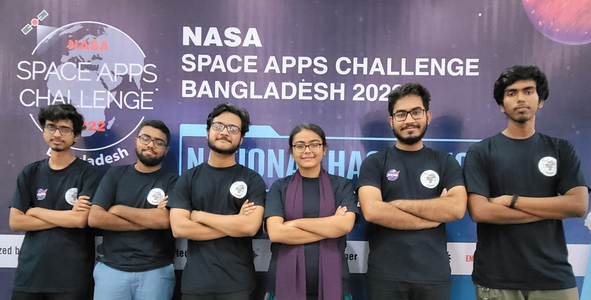
Our team, Icarus, constitutes of members that collaborated from 3 different institutions, out of our common love for astronomy and making an impact in the world. We consider challenges as an opportunity to grow, and develop ourselves so that we can manifest that ideal.
We want to make the world more inquisitive about the achievement and the milestones set by Parker Solar Probe and the mysteries it is trying to unfold but in the most immersive and compelling way possible.
Throughout this journey one of our main challenges apart from handling the tech stacks and incorporating everything together was to narrate the complexities of this engineering marvel in the most digestible way so that anyone can grasp it easily.
We would very much like to thank BASIS for organizing such a well-strategized local event for Nasa Space Apps Challenge 2022, and mentoring us continuously throughout the last few months via bootcamps and endless support.
https://docs.unity3d.com/Manual/index.html
#art #vr #videogame #game #immersive #ParkerSolarProbe #spaceprobe #probe #mixedreality #googlecardboard #gamedevelopment


